
If you’ve ever had “fast internet” at the modem but slow Wi-Fi in the bedroom, you already know the truth: Wi-Fi performance is mostly about coverage consistency, not your ISP plan.
A modern mesh system fixes this by placing several nodes around your home. This lets your devices move from room to room without losing connection, so speed and latency stay steady for things like Zoom calls, gaming, streaming, and smart-home devices.
This guide compares five Wi-Fi 7 mesh systems, ranging from the best value for most homes to high-end, multi-gig options with no compromises.
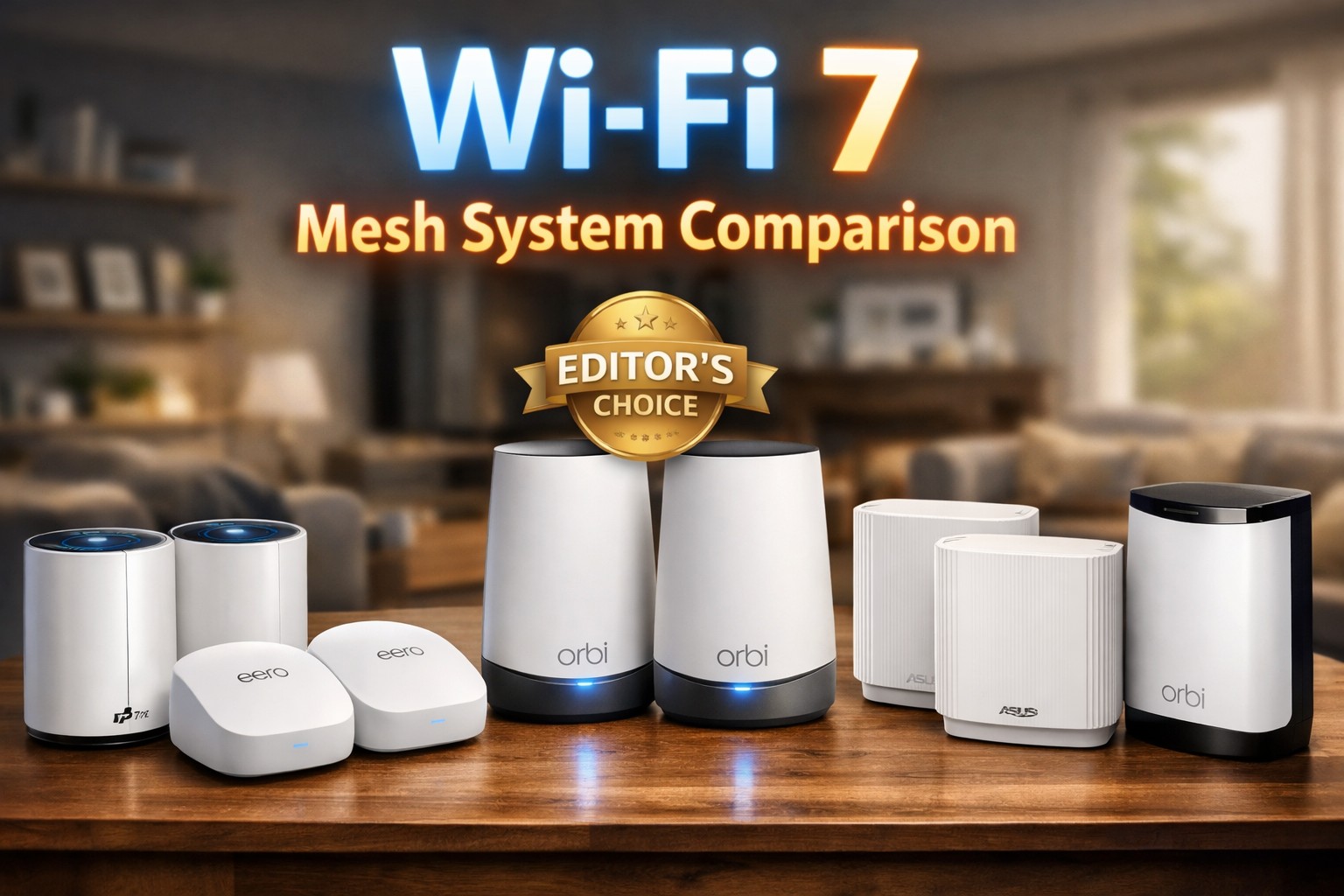
Editor’s Choice: NETGEAR Orbi 770 (Best for Most Homes)
If you want a mesh system that is fast, stable, future-proof with Wi-Fi 7, and easy to use, the Orbi 770 is a great choice.
Reviewers like its stability and strong performance throughout the home. The main downside is that some advanced features, such as security and parental controls, require a subscription.
Why it wins
- Strong Wi-Fi 7 speeds and excellent coverage potential
- Useful wired ports, including 2.5G WAN and several 2.5G LAN ports on the router
- A system you can set up once and rely on, even in busy households
✅ Buy the NETGEAR Orbi 770 Now🛒
Stay Connected Anywhere with Our Favorite Portable WiFi Mobile Hotspot!
Experience seamless connectivity on-the-go with our portable WiFi mobile hotspot. Stay connected with high-speed internet wherever you are.
Stay connected on-the-go! Get your portable WiFi mobile hotspot today and enjoy reliable internet wherever you travel.
Which Mesh Is Right For You?
Answer 6 quick questions and I’ll recommend the best Wi-Fi 7 mesh system for your home + usage.
Coverage depends on layout/materials. For best results, place a node halfway between your router and weak zones (not inside the weak zone).
The 5 Best Mesh Systems
1) TP-Link Deco 7 Pro (Deco BE63) – Best Value for Big Coverage and Multi-Gig Ports
Best for households that want strong Wi-Fi 7 coverage and plenty of 2.5G wired options, without paying ultra-premium prices.
The Deco 7 Pro, often sold as Deco BE63, is a tri-band Wi-Fi 7 mesh system. TP-Link promotes it as a whole-home, multi-gig mesh with modern Wi-Fi 7 features such as Multi-Link Operation (MLO) and wide channels.

What you’ll love
- Up to 7,600 sq ft coverage in a 3-pack claim (great for larger homes)
- Each unit has four 2.5G WAN/LAN ports and a USB port, which is rare at this price level.
- Wi-Fi 7 features are designed to improve speed and reduce latency on compatible devices.
Tradeoffs
- If you need 10G ports, you will have to consider higher-end models or other brands.
- Like many modern mesh systems, most management is done through an app.
Pros
- Excellent port flexibility for wired devices
- Strong coverage claim for a 3-pack
- Substantial value for a Wi-Fi 7 system
Cons
- No 10G ports
- Advanced customization is more limited compared to enthusiast routers
Key specs (highlights)
- Tri-band Wi-Fi 7, up to ~10 Gbps class
- 3-pack coverage claim: up to 7,600 sq ft
- 4× 2.5G WAN/LAN + USB
If you want the latest Wi-Fi technology and real wired usability without paying flagship prices, this is a great choice.
🛒 Buy TP-Link Deco 7 Pro (Deco BE63)
2) eero Pro 7 – Easiest Setup and Best for people who want a Wi-Fi 7 mesh system that is simple, stable, and easy to maintain.
The eero Pro 7 is made for homes that want Wi-Fi 7 benefits without any hassle. Eero says it supports plans up to 5 Gbps, with two 5GbE ports and up to 3.9 Gbps wireless speeds.
It is also promoted as a smart-home hub, with support for Thread, Zigbee, and Matter, as highlighted in eero’s materials and reviews.

What you’ll love
- Extremely approachable setup and day-to-day use
- Each unit has two 5 GbE ports, which is excellent for setting up a clean, wired backbone.
- It works well if you already use eero or Amazon smart home devices.
Tradeoffs
- Some features, such as advanced security and parental controls, require an eero Plus subscription.
- Each unit covers about 2,000 square feet, so larger homes will usually need a multi-pack.
Pros
- Easy and reliable experience
- Strong multi-gig wiring potential with dual 5GbE
- Smart-home friendly features
Cons
- Subscription upsells for advanced features.
- Not the fastest raw spec sheet in this lineup
Key specs (highlights)
- Tri-band Wi-Fi 7
- Wireless up to 3.9 Gbps; two 5GbE ports
- 2,000 sq ft per unit claim Eero
3) NETGEAR Orbi 770 – Best Overall Balance (Editor’s Choice)
Best for most households that want strong mesh performance with Wi-Fi 7, good coverage, and wired flexibility, but without the high cost of flagship systems.
Orbi 770 is a tri-band Wi-Fi 7 mesh system rated up to 11 Gbps and with a claimed coverage of up to 8,000 sq ft (3-pack).
It also includes a 2.5G WAN port and several 2.5G LAN ports on the router, plus 2.5G LAN ports on the satellites.
Review coverage has emphasized reliability and consistent performance, while noting subscriptions for security/parental controls.

Pros
- Excellent reputation for reliable whole-home coverage
- Strong selection of ports for wired devices, including 2.5G WAN and LAN
- Great performance ceiling for busy homes
Cons
- NETGEAR Armor and advanced parental controls require paid plans after trial
- Advanced settings are more limited than hardcore enthusiast routers (by design)
Key specs (highlights)
- Tri-band Wi-Fi 7, up to 11 Gbps class
- Router ports: 1× 2.5G WAN + 3× 2.5G LAN
- Satellite ports: 2× 2.5G LAN each
🛒 Buy NETGEAR Orbi 770
4) ASUS ZenWiFi BT10 – Best for Power Users (10G Options and Flexibility)
Best for users who want Wi-Fi 7 mesh and also value wired backhaul, fast ports, and more control.
ASUS positions the ZenWiFi BT10 as a tri-band Wi-Fi 7 mesh system with speeds up to 18 Gbps and coverage up to 6,000 sq ft (2-pack).
It also stands out for its 10G networking options, with a 10G WAN/LAN port and a 10G LAN port.

Pros
- Excellent for wired backhaul and multi-gig setups thanks to its 10G ports
- Strong Wi-Fi 7 spec positioning (18 Gbps class)
- A great choice if you want more advanced, router-like features in a mesh system
Cons
- As with many Wi-Fi 7 systems, you will see the most benefit if your devices also support Wi-Fi 7.
- Coverage is good, but not as extensive as the Orbi 770 or 970 packs, which are better for very large homes.
Key specs (highlights)
- Up to 6,000 sq ft (2-pack)
- Ports: 1× 10G WAN/LAN, 1× 10G LAN, 1× 1G WAN/LAN, USB 3.0
- Tri-band Wi-Fi 7, up to 18 Gbps class
5) NETGEAR Orbi 970 Series – Best No-Compromise Mesh (If Budget Is Not a Concern)
Best for large homes, very busy networks, creators, gamers, and anyone who needs 10G wired connections and top-tier Wi-Fi 7.
This is the flagship. Orbi 970 is a quad-band Wi-Fi 7 mesh system rated up to 27 Gbps and designed to keep Wi-Fi fast across up to 200 devices.
Wired connectivity is a major feature, with 10G WAN, 10G LAN, and four 2.5G LAN ports.
Multiple reviews describe it as an exceptional performer—but also highlight that it’s overkill/expensive for most households.

Top-tier specifications and a quad-band design
- Built for multi-gig internet and advanced wired networking with 10G support
- Excellent for massive device counts and demanding traffic
Cons
- The price-to-benefit ratio is hard to justify for typical homes.
- NETGEAR’s security/parental plans may require subscriptions after trial
Key specs (highlights)
- Quad-band, up to 27 Gbps class; coverage ~3,300 sq ft per router (expandable)
- Ports: 10G WAN, 10G LAN, 4× 2.5G LAN
- Designed for up to 200 devices

Best Picks for Different Needs
- Best overall (Editor’s Choice): NETGEAR Orbi 770
- Best value big-home coverage: TP-Link Deco 7 Pro (Deco BE63)
- Best “set it and forget it”: eero Pro 7
- Best for 10G connections and power users: ASUS ZenWiFi BT10
- Best if budget is not a concern: NETGEAR Orbi 970 Series
Buying Guide: How to Choose the Right Mesh System
Choose based on your home size
- Up to ~2,000 sq ft: eero Pro 7 (1 unit) can work; add nodes if you have dead zones.
- 2,000–5,000 sq ft: most 2-packs fit here (BT10 2-pack is rated up to 6,000 sq ft).
- 5,000+ sq ft / multi-floor + outdoor edges: Orbi 770 (3-pack coverage claim up to 8,000 sq ft) or Deco BE63 3-pack (up to 7,600 sq ft).
Pick by internet speed tier
- Up to 1 Gbps: Orbi 770 / Deco BE63 are incredible “future-proof but not absurd” choices.
- 1–5 Gbps: eero Pro 7 is marketed for plans up to 5 Gbps (wired).
- For homes with multi-gig internet and lots of wired devices, the Orbi 970’s 10G WAN/LAN setup is ideal.
Backhaul is more important than many people think.
- If you can run Ethernet backhaul, do it. It’s the cleanest way to stabilize node speeds.
- Otherwise, choose tri-band or quad-band mesh systems with strong backhaul designs. The Orbi series, for example, focuses on backhaul and Wi-Fi 7 features like MLO.
FAQ
Is Wi-Fi 7 worth it right now?
If you are buying a new mesh system now, Wi-Fi 7 can be worth it for future-proofing and features like wider channels and Multi-Link Operation. However, you will notice the biggest improvements when your devices also support Wi-Fi 7.
Do I need 10G ports?
You only need 10G ports if you have or plan to have multi-gig internet, a multi-gig NAS, or a lot of wired workstations. For most homes, 2.5G is more than enough.
Are subscriptions required?
Subscriptions are not required for basic Wi-Fi, but:
- NETGEAR Armor requires a paid subscription after the free trial.
- Eero offers advanced security/parental tools via an eero Plus subscription.
What’s the easiest mesh system for non-technical users?
Eero is known for providing a smooth experience and is designed to be simple to use. You want the safest “buy it once and stop thinking about Wi-Fi” choice, NETGEAR Orbi 770 is the best overall balance of speed, coverage potential, and wired flexibility—without the extreme cost of flagship systems.
If you’re optimizing for different priorities: